- Leadership
- Mental Models
- Change Management
Yerkes-Dodson Law
Performance achieves its peak when an individual experiences an optimal, moderate level of physiological or psychological pressure.
The fundamental principles of this widely recognized psychological framework emerged from the work of two American scientists, Robert Mearns Yerkes and John Dillingham Dodson, in the early years of the 20th century. Their findings were first published in a significant 1908 paper, titled The Relation of Strength of Stimulus to Rapidity of Habit-Formation. The initial conceptualization was deeply rooted in comparative psychology, using animal experimentation to explore how varying levels of stimulus intensity influenced learning speed.
Their original research involved a series of controlled experiments conducted on Japanese dancing mice. The specific task required the mice to develop a discrimination learning habit: correctly choosing a black box over a neighboring white box to avoid receiving an electric shock. Yerkes and Dodson systematically varied the strength of the electric shock — which served as the primary motivational stimulus or “punishment” — across different groups of subjects. In their first experimental sequence, they observed that extremely weak shocks took an excessively long time for the mice to master the habit. When the researchers moderately increased the stimulus strength, the number of necessary trials for correct discrimination dramatically decreased, indicating faster learning. However, at the most potent, strongest level of shock, the learning rate surprisingly deteriorated, requiring more trials once again. This finding contradicted their initial expectation that learning efficiency would increase linearly with the electric current’s strength. Instead, the scientists discovered a non-linear relationship where a middling degree of stimulation proved most effective for habit formation.
Following this unexpected yet vital result, they broadened their investigation, manipulating the difficulty of the discrimination task itself. By making the difference between the white and black boxes easier to discern (e.g., by altering light levels), they observed that the strongest stimulus actually led to the fastest learning, appearing to challenge the initial U-shaped result. This introduced a critical nuance: the optimal level of stimulus seemed intrinsically linked to the inherent difficulty of the task. They summarized their conclusion with the enduring insight that as the complexity of the discrimination challenge increases, the intensity of the stimulus that best supports learning must decrease, moving closer to the subject’s sensory threshold.
Despite its foundational nature, this work remained relatively overlooked in the psychological community for decades. Its prominence was significantly revitalized in the 1950s, largely due to Donald Hebb’s pioneering work on the general concept of arousal and his theoretical proposition of an inverted-U relationship between activation and performance. Hebb’s broader framework provided the necessary conceptual language to apply the initial, specific findings about “punishment” and “learning” to the much wider domains of “arousal” and “performance” in human behavior, cementing the Yerkes-Dodson Law’s place as a fundamental principle in various fields of professional and academic study.
The Framework
The Yerkes-Dodson Law serves as a powerful metaphor for understanding human productivity and cognitive efficiency, representing a delicate equilibrium between inertia and overload. It moves beyond a simple linear cause-and-effect model to illustrate that human capacity is curvilinear, peaking at a point of mobilized engagement before collapsing under excessive duress.
The Inverted U-Curve
The most common visual representation of the law is the inverted U-curve, a sweeping arch that maps performance on the vertical axis against the level of physiological or psychological arousal on the horizontal axis. This curve dictates that when arousal is very low, perhaps characterized by boredom, lack of interest, or comfort, performance remains sluggish. An athlete on a day off or an employee facing no deadline may experience this state of under-arousal; they possess the capacity but lack the necessary energetic input to execute.
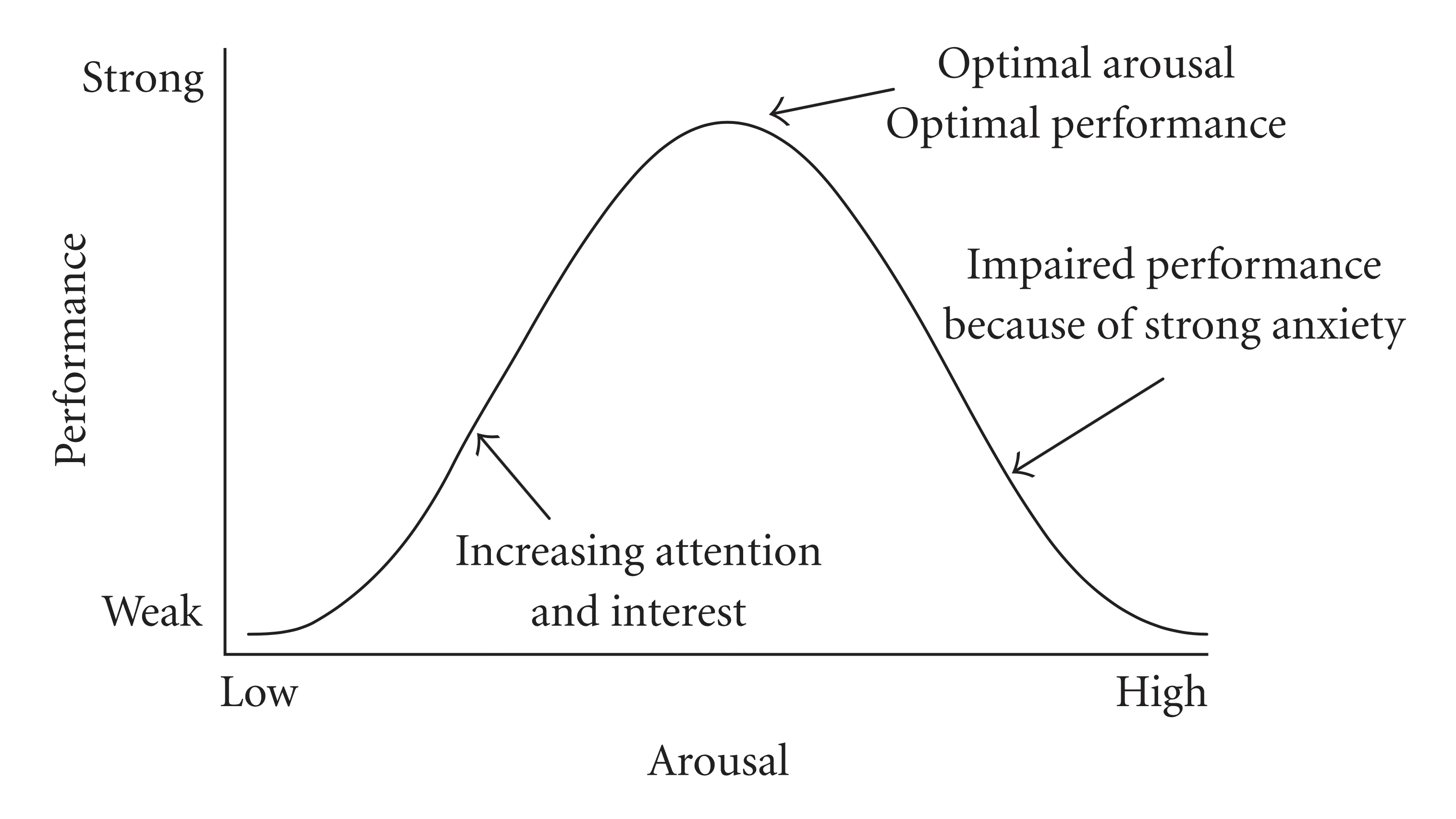
As the motivational state escalates — through a deadline, competitive pressure, or intellectual challenge — the individual moves up the left side of the curve. The nervous system becomes engaged, attention focuses, and relevant cognitive resources mobilize. This ascending phase is where positive stress, often termed eustress, acts as a catalyst for enhanced productivity. The brain shifts into a state of heightened readiness, improving reaction times and sharpening concentration.
The crest of the curve represents the Optimal Arousal Zone. This is the state where the individual is perfectly engaged — neither bored nor overwhelmed — leading to maximized speed, accuracy, and overall output. Here, the energy expenditure matches the task demands precisely. However, the moment arousal continues to climb past this peak, the detrimental effects of distress begin to manifest. Cognitive resources become hijacked by the emotional state; focus narrows (a phenomenon sometimes called ‘tunnel vision’), decision-making becomes impulsive, and the capacity for complex reasoning plummets. This descent constitutes the right side of the inverted U, where high anxiety and excessive pressure actively degrade performance, turning a highly motivated individual into a highly anxious and ineffective one.
Task Complexity As The Governing Variable
The critical insight offered by Yerkes and Dodson, which elevates the law beyond a mere statement of moderation, is that the exact position of this optimal peak fundamentally depends on the nature of the task being attempted. The complexity of the challenge acts as a major mediating factor, shifting the entire curve horizontally along the arousal axis.
- Complex and Unfamiliar Tasks (The Low-Arousal Sweet Spot): For tasks requiring deep concentration, novel problem-solving, meticulous analytical reasoning, or the generation of creative solutions, the optimal level of arousal is lower and less intense. Consider a financial derivatives trader analyzing a complex structured product or a surgeon performing a delicate procedure; both require precise, measured, and error-free cognitive processing. In these situations, even a moderate increase in pressure, such as a looming time constraint or high emotional stakes, can introduce cognitive noise, distracting working memory and causing critical mistakes. High anxiety leads to cognitive rigidity, preventing the flexible thinking required to navigate novel challenges. Therefore, the peak performance for complex tasks exists at a position closer to the lower end of the arousal spectrum, favoring calm, focused engagement over energetic, high-octane drive
- Simple and Well-Practiced Tasks (The High-Arousal Tolerance): Conversely, for tasks that are straightforward, highly repetitive, physically driven, or deeply ingrained through practice (over-learned), the optimal arousal level is considerably higher. A factory worker executing a repetitive assembly task, a sprinter exploding from the starting blocks, or a data entry clerk processing forms are examples of tasks that benefit from elevated drive. Because the cognitive load is minimal, higher levels of physiological activation, such as an increased heart rate and adrenaline, enhance performance by boosting energy, speed, and endurance without causing confusion. A basketball player making a free throw, a highly rehearsed action, often benefits from the competitive pressure of the crowd, using that energy to fuel the execution. For these simpler tasks, the performance curve shifts toward the right, allowing for a broader band of effective performance under significant pressure
Neural Mechanisms And Cognitive Interference
The neurological basis for this differential response lies in how the brain manages attentional resources under stress. The brainstem’s Reticular Activating System (RAS) controls general arousal, influencing alertness and wakefulness. As arousal increases, the sympathetic nervous system is activated, releasing neurotransmitters like norepinephrine and dopamine.
In situations of low to optimal arousal, these neurotransmitters enhance the function of the prefrontal cortex (PFC), the brain’s center for executive function, planning, and focus. This moderate enhancement facilitates working memory and sustained attention, which are vital for complex tasks. This is the upswing of the curve.
However, when arousal becomes excessive, the amygdala, the brain’s threat-detection center, overpowers the PFC. The overwhelming influx of stress hormones, particularly cortisol, floods the system. This hormonal cascade initiates a protective narrowing of attention, which is highly effective in survival situations (e.g., focusing solely on a weapon in a confrontation) but disastrous for complex, non-survival tasks. This narrow focus crowds out the capacity for peripheral information processing, flexible strategy shifts, and complex cognitive synthesis, leading to the rapid decay of performance observed on the right side of the inverted U. For simple tasks, this narrowed, focused energy can still successfully drive the motor response; for complex tasks, it amounts to cognitive paralysis.
Real-World Application
The practical implication of the Yerkes-Dodson Law is the necessity of arousal-task matching. A coach motivating a novice chess player (complex task) must use gentle encouragement to keep arousal low and focus sharp. The same coach motivating a swimmer to shave milliseconds off a sprint time (simple/physical task) might use intense, high-energy language to drive the competitor closer to their maximum physical threshold. Managers, too, must understand this dynamic: assigning a new, challenging strategic initiative to an employee with an aggressive, short deadline (high pressure) is likely to trigger distress and failure, whereas applying similar high pressure to a familiar reporting or inventory task will likely accelerate its completion. Effectively, success depends on calibrating the psychological pressure, or drive, to the cognitive and physical demands of the specific activity.
Case of Tesla, Inc.
Tesla, Inc. provides a compelling case study of the Yerkes-Dodson Law in the context of high-stakes corporate innovation, particularly concerning the differing demands of complex conceptual tasks versus simple production tasks. The company, led by its famously intense chief executive, operates under a pervasive culture of urgency, aggressive goal-setting, and perpetual high pressure. This environment serves as a constantly high-arousal stimulus for its workforce.
The Complex Task Failure: The “Production Hell” of Model 3
The launch of the mass-market sedan, the Model 3, was famously dubbed “production hell” by the company’s leadership, a period when the complexity of automating the assembly line overwhelmed the system. Designing a new car is an intensely complex task, demanding low-arousal, meticulous effort across engineering, material science, and design teams. The initial phases — which involve novel battery architecture, custom robotics, and integrating proprietary software — are highly intellectual and fall on the left side of the Yerkes-Dodson curve, demanding a lower optimum of pressure.
However, Tesla applied an extremely high-arousal environment — publicly set, implausibly ambitious production targets (e.g., 5,000 cars per week), continuous media scrutiny, and 24/7 operational demands — to this early, complex phase. The result was a catastrophic misalignment: the excessive pressure (high arousal) applied to a highly complex and novel problem led to systemic failure. Engineers and factory personnel, under duress, rushed design decisions, skipped necessary testing protocols, and over-engineered processes that ultimately slowed down production rather than accelerating it. This led to significant quality control issues, repeated reworks, and the infamous installation of a giant, overly complex robotic structure (the “alien dreadnought”) that failed to deliver its promise, representing a performance decline due to over-arousal in a complex problem-solving scenario. The company eventually had to simplify the processes and manually build parts of the line in tents, effectively lowering the complexity and, temporarily, the necessary pressure.
The Simple Task Success: Ramping Up High-Volume Output
Once the fundamental engineering design was stabilized, the challenge transitioned into a relatively simpler, more routine task: the sheer volume ramp-up of repetitive assembly. While demanding, this phase is characterized by high-volume, standardized, well-defined procedures that are learned and repeated hundreds of thousands of times. This activity sits on the right side of the Yerkes-Dodson curve, where high arousal is beneficial.
The sustained, high-pressure environment — driven by the CEO’s demands for speed and efficiency — worked effectively during this stage. The intense focus on meeting delivery quotas, optimizing minor steps, and driving continuous process improvement through relentless operational pressure successfully mobilized the workforce. The pressure, which had previously caused intellectual and engineering errors, now functioned as an accelerant for the physically and temporally driven production line. The workers, now executing highly practiced routines, used the adrenaline and sense of urgency to sustain long hours and execute tasks with high repeatability, ultimately leading to the record-breaking production volumes that cemented Tesla’s market position. The company’s management style, while detrimental during the initial complex design phase, proved optimally suited for the later, simpler task of mass manufacturing.
Written by

Mithun Sridharan
Founder, LinkPress
Mithun is a strategist, advisor, educator, and speaker focused on helping leaders make better decisions in environments shaped by change, complexity, and emerging technology. His work brings together leadership, management consulting, digital transformation, and artificial intelligence in a way that is practical, grounded, and commercially relevant.
Related Posts
SMCR Model
Why messages fail before they reach anyone
Mithun Sridharan- Communication
- Leadership
- Mental Models
- Change Management
Community
What Makes Someone a Leader
Leadership psychology and studies on being a Leader
Mithun Sridharan- Leadership
- Psychology
- Mental Models
Business Coach vs Management Consultant
Developing the Leader versus Solving the Structural Problem
Mithun Sridharan- Strategic Management
- Leadership
- Decision-Making
- Executive Coaching
- Business Strategy
- Change Management