- Strategic Management
- Organization Design
- Principle
- Professional Services
- Leverage
- Ratios
- Consulting
- Career Paths
Professional Services Pyramid
Leverage ratios and role clarity determine firm profitability and client impact
Corporate law firms, engineering groups and strategy houses operate on a fundamental structural logic known as the pyramid. This model serves as the primary mechanism for distributing work, managing risk and generating profit. While many business school students view the pyramid as a simple hierarchy, it actually functions as a sophisticated Leverage Engine. It matches the complexity of a task with the cost and experience of the professional performing it. When the engine runs smoothly, the firm produces high-margin results. When it breaks, the firm experiences Leverage Collapse, where senior time is wasted on junior tasks.
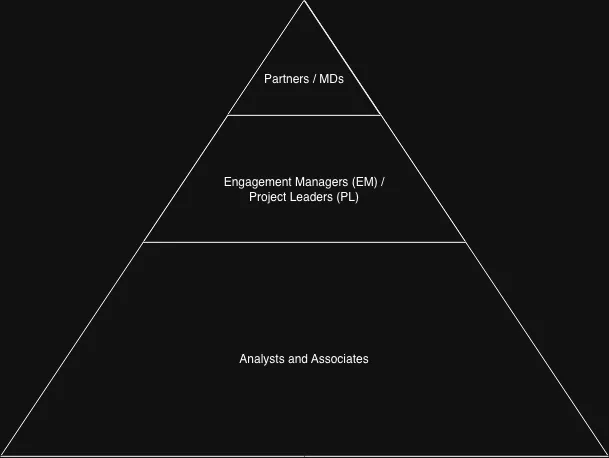
A healthy pyramid requires a precise Leverage Ratio — the number of junior staff supporting each senior leader. This ratio determines the Economic Velocity of the firm. In a high-leverage model, a small group of Partners oversees a vast base of Analysts and Associates. In a low-leverage model, usually reserved for highly specialized Boutique advisory work, the structure flattens. Understanding these dynamics allows executives to evaluate whether their service providers are structured for Scale or Specialization.
The Base: Analysts and the Foundation of Truth
The bottom of the pyramid represents the Execution Layer. Here, Analysts and junior Consultants transform raw data into Analytical Building Blocks. Their mandate focuses on Data Integrity and Granular Accuracy. They inhabit the world of the Hard Skill. When a firm promises a Data-Driven Strategy, the Analysts perform the thousands of calculations required to validate that claim.
Think of the base as the Laboratory. Analysts act as the technicians who ensure the test results remain beyond reproach. They master tools like Excel, SQL (Structured Query Language) and various Artificial Intelligence (AI) data cleaning scripts. Their value lies in their Throughput and Precision. If the Analyst makes a mistake in a single cell of a financial model, the entire strategic recommendation at the top of the pyramid may crumble.
For the professional, this stage is an Apprenticeship of Detail. They learn to see patterns in market share data or customer behavior that are invisible to the untrained eye. Success at the base requires a move from Following Instructions to Anticipating Needs. An Analyst who discovers a data anomaly and investigates its cause without being asked is already moving toward the next tier of the pyramid.
The Mid-Section: Managers and the Bridge of Synthesis
The middle of the pyramid represents the Synthesis Layer. Managers and Engagement Managers (EM) act as the Connective Tissue of the organization. They possess the Translation Skills necessary to turn raw data from the base into Strategic Insights for the top. While the base asks How?, the middle tier asks So What?.
Managers manage the Friction of Delivery. They balance the Operational Reality of the team’s bandwidth with the High Expectations of the client. They function as the Filter. A Manager reviews the output of three Analysts and selects the five key data points that will move the needle for the board. They are the Narrative Architects, ensuring that the project tells a coherent story rather than just presenting a pile of facts.
The middle tier also serves as a Buffer. They protect the junior staff from Scope Creep — the tendency for projects to expand beyond their original boundaries — while protecting the Partners from the Technical Weeds. If the base is the laboratory, the middle tier is the Doctor who interprets the lab results and prepares a diagnosis. Their focus is Delivery Excellence and Team Cohesion.
The Apex: Partners and the Stewardship of Trust
The top of the pyramid represents the Stewardship Layer. Partners and Managing Directors (MD) own the Commercial Vitality and Institutional Reputation of the firm. At this level, the primary product is no longer a document or a model; it is Confidence. Partners manage the Macro-Context of the client relationship.
Partners operate as the Market-Makers. They spend their time in C-Suite (Chief Officers) offices, discussing Enterprise-Level Risks and Growth Strategies that have not yet been defined as projects. Their value lies in their Gravitas and External Perspective. They provide the Strategic Foresight that justifies the firm’s presence in the boardroom. A Partner’s success is measured by Revenue Generation and Client Lifetime Value (LTV).
Beyond sales, the apex manages the Firm’s Capital. They make decisions about Partner Compensation, Strategic Planning (SP) and Brand Positioning. They are the Owners. They ensure that the pyramid remains Structurally Sound by hiring the right talent at the base and promoting the right leaders in the middle. If the middle tier is the Doctor, the Partner is the Hospital Board ensuring the institution remains solvent and prestigious.
The Economic Peril of the “Hollow” Pyramid
Strategic Erosion occurs when the leverage ratio of the pyramid becomes skewed. This leads to two distinct types of organizational failure: the Top-Heavy firm and the Bottom-Heavy firm.
In a top-heavy firm, there are too many Partners and not enough Analysts. This leads to Juniorized Partners — senior leaders who spend their time fixing formatting on slides or building their own models because there is no one else to do it. This is a Value Disaster. The client pays a Partner Premium for work that should cost a fraction of the price. The firm’s Contribution Margin collapses because the most expensive people are performing Low-Leverage tasks.
In a bottom-heavy firm, the leverage ratio is too high. A single Manager might be overseeing twelve Analysts across four different projects. This leads to a Supervision Gap. Without enough Senior Review, the quality of the work product declines. Errors slip through the cracks and the Strategic Logic becomes shallow. The firm becomes a Commodity Factory, churning out high volumes of work that lacks the Nuance required for complex problem-solving.
Visualizing the Flow of Value: The Waterfall Metaphor
One can visualize the pyramid as a Value Waterfall.
- Investment flows Up: The Partners invest the firm’s “Capital” and “Reputation” into the base to hire and train the best Analysts
- Data flows Up: The Analysts provide the “Empirical Evidence” that moves up through the Manager’s filter to the Partner’s narrative
- Wisdom flows Down: The Partner’s “Experience” and “Strategic Direction” flow down to guide the Manager’s synthesis and the Analyst’s execution
Strategic excellence occurs when these flows are In Equilibrium. A firm where wisdom does not flow down becomes a Sweatshop where juniors work without purpose. A firm where data does not flow up becomes an Opinion Shop where Partners guess instead of knowing.
The Impact of Technology on the Pyramid
The rise of Generative AI (GenAI) and Automated Analytics is currently Reshaping the Foundation of the Professional Services Pyramid.
Shrinking the Base
As software begins to handle the Heavy Lifting of data cleaning, basic modeling and slide formatting, the need for a massive base of junior Analysts may decrease. This creates a Structural Tension. If the base of the pyramid shrinks, how does the firm Train the Next Generation of leaders? Historically, Analysts learned the business by doing the grunt work. Firms must now find new ways to provide Exposure and Experience to junior staff in an automated environment.
Elevating the Middle
Technology is pushing the Synthesis Layer lower down the pyramid. A second-year Consultant with the right AI Tools can now perform the work that previously required a Manager. This allows the Manager to focus on more complex Stakeholder Management and Change Management (CM). The Cognitive Bar for entry-level roles is rising. The modern Analyst must be more than a Data Processor; they must be a System Orchestrator.
Written by

Mithun Sridharan
Founder, LinkPress
Mithun is a strategist, advisor, educator, and speaker focused on helping leaders make better decisions in environments shaped by change, complexity, and emerging technology. His work brings together leadership, management consulting, digital transformation, and artificial intelligence in a way that is practical, grounded, and commercially relevant.
Related Posts
Advisory Board vs Steering Committee
Confusing advice with authority leads to accountability gaps and organizational paralysis
Mithun Sridharan- Strategic Management
- Governance
- Leadership
- Business Strategy
- Organization Design
- Decision-Making
SOLID Design Principles
Five engineering principles that govern scalable organizations
Mithun Sridharan- Principle
- Organization Design
- Concepts
Consultant vs Advisor
Misunderstanding these roles leads to mismatched expectations and ineffective professional engagements
Mithun Sridharan- Business Strategy
- Coaching
- Strategic Management
- Professional Services
- Trusted
- Advisor
- CRM