- Techniques
- Innovation
- Methodologies
How-Now-Wow Matrix
Prioritize ideas by ease of implementation and potential impact
The How-Now-Wow matrix is a simple yet effective framework for evaluating and prioritizing ideas. It operates on two key dimensions: “How” and “Wow.” The “How” axis represents the feasibility or ease of implementation. It considers factors like available resources, time constraints, technical complexity, and required expertise. Ideas that are easy to implement score high on the “How” axis. The “Wow” axis represents the potential impact or value of the idea. This encompasses factors like market potential, customer satisfaction, revenue generation, cost savings, and strategic alignment. Ideas with high potential impact score high on the “Wow” axis.
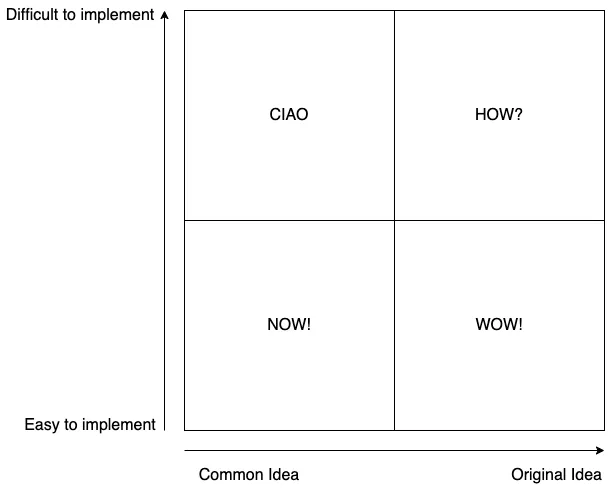
The matrix is divided into four quadrants, each representing a distinct category of ideas:
- Quick Wins (High How, High Wow): These are the most desirable ideas. They are easy to implement and offer significant impact. These should be prioritized and executed immediately. They represent low-hanging fruit and offer quick returns on investment
- Major Projects (Low How, High Wow): These ideas have high potential impact but are challenging to implement. They often require significant resources, time, and expertise. These projects should be carefully evaluated and planned. They represent strategic initiatives with long-term potential
- Fillers (High How, Low Wow): These ideas are easy to implement but offer limited impact. They should be considered only if resources are available after addressing Quick Wins and Major Projects. They might be useful for minor improvements or quick fixes, but they shouldn’t be the primary focus
- Hard Slog (Low How, Low Wow): These ideas are difficult to implement and offer minimal impact. They should be avoided unless there are compelling reasons to pursue them. They represent a drain on resources with little to no return
The power of the How-Now-Wow matrix lies in its simplicity and visual nature. It provides a clear and concise way to compare and contrast different ideas, facilitating informed decision-making. It also encourages a balanced approach, considering both feasibility and impact.
Application
Using the How-Now-Wow matrix is a straightforward process:
- Generate a List of Ideas: Begin by brainstorming a comprehensive list of ideas related to a specific goal or challenge
- Define Evaluation Criteria: Clearly define the criteria for evaluating “How” and “Wow.” This ensures consistency and objectivity. For “How,” consider factors like cost, time, resources, and complexity. For “Wow,” consider factors like market potential, customer value, revenue impact, and strategic alignment
- Score Each Idea: For each idea, assign a score for “How” and “Wow” on a defined scale (e.g., 1-5, 1-10). A higher score indicates greater ease of implementation or higher potential impact
- Plot the Ideas on the Matrix: Plot each idea on the matrix based on its “How” and “Wow” scores. This creates a visual representation of the ideas’ strategic value
- Prioritize and Act: Based on the quadrant each idea falls into, prioritize and take action. Focus on Quick Wins first, then carefully plan Major Projects. Consider Fillers only if resources allow, and avoid Hard Slogs
Case study - Developing a New Marketing Campaign
Imagine a marketing team tasked with developing a new campaign to increase brand awareness. They generate several ideas:
- Social Media Contest: Run a contest on social media platforms, encouraging user-generated content and offering prizes
- Television Advertisement: Create and air a high-quality television commercial during prime time
- Influencer Marketing Campaign: Partner with relevant influencers to promote the brand to their followers
- Local Community Event Sponsorship: Sponsor a local community event to increase visibility and engagement
The team then evaluates each idea using the How-Now-Wow matrix:
- Social Media Contest: High How (easy to set up and manage), Medium Wow (potential for good reach and engagement)
- Television Advertisement: Low How (expensive and complex to produce), High Wow (potential for massive reach and brand awareness)
- Influencer Marketing Campaign: Medium How (requires research and negotiation with influencers), Medium Wow (targeted reach and credibility)
- Local Community Event Sponsorship: High How (relatively easy to organize), Low Wow (limited reach and impact)
Plotting these ideas on the matrix would place them in the following quadrants:
- Social Media Contest: Quick Wins
- Television Advertisement: Major Projects
- Influencer Marketing Campaign: Somewhere between Quick Wins and Major Projects, depending on the specific influencer strategy.
- Local Community Event Sponsorship: Fillers
Based on this analysis, the team would prioritize the Social Media Contest as a Quick Win, offering a good balance of ease of implementation and potential impact. They would then carefully plan the Television Advertisement as a Major Project, recognizing its high potential but also its complexity and cost. The Influencer Marketing Campaign would be further evaluated to determine its exact placement on the matrix and subsequent priority. The Local Community Event Sponsorship would be considered only if resources allowed, as its impact is limited.
Variations and Adaptations
While the basic How-Now-Wow matrix is effective, it can be adapted to suit specific needs:
- Weighted Scoring: Instead of simple scoring, weighted scoring can be used to reflect the relative importance of different evaluation criteria within “How” and “Wow”
- Additional Criteria: Additional criteria can be added to the matrix, creating a more complex but potentially more comprehensive evaluation framework
- Combined with Other Tools: The matrix can be used in conjunction with other prioritization tools, such as MoSCoW (Must have, Should have, Could have, Won’t have) or value vs. effort matrices, for a more robust analysis
Written by

Mithun Sridharan
Founder, LinkPress
Mithun is a strategist, advisor, educator, and speaker focused on helping leaders make better decisions in environments shaped by change, complexity, and emerging technology. His work brings together leadership, management consulting, digital transformation, and artificial intelligence in a way that is practical, grounded, and commercially relevant.
Related Posts
SQDC
Safety, Quality, Delivery, Customer, and Cost must align
Mithun Sridharan- Frameworks
- Methodologies
- Techniques
SOAP Notes
SOAP notes are a standardized method of documentation that healthcare professionals use to record patient information
Mithun Sridharan- Concepts
- Techniques
- Methodologies
Wicked Questions
Wicked Questions helps groups explore seemingly paradoxical or contradictory forces that exist within complex challenges
Mithun Sridharan- Techniques
- Methodologies