- Psychology
- Concepts
- Mental Models
Decoy Effect
The decoy effect refers to the phenomenon where people tend to change their original preference between two choices when they are presented with an asymmetric third choice
Also known as the asymmetric dominance Effect, decoy effect refers to the phenomenon where people tend to change their original preference between two choices when they are presented with an asymmetric third choice . Consumers might increase their preference for a product that is of better quality over a cheaper product that is of lower quality when they are presented with a third choice that is relatively worse than the First product in terms of quality, price, or both . Postulated by American marketing professor Joel Huber, the decoy effect is employed by marketing companies to influence the choices of consumers in a subtle manner .
Why does this effect happen?
At its core, the Decoy Effect exploits our tendency to make decisions based on relative comparisons rather than absolute values. When presented with only two options, consumers often struggle to determine the best choice, especially if the options differ in multiple attributes. However, the addition of a carefully crafted decoy option can simplify this decision-making process by providing a clear point of comparison.
This effect is particularly powerful because it leverages several psychological principles.
First, it taps into our innate desire for value, making the target option seem like a better deal in comparison to the decoy. Second, it reduces choice anxiety by providing an easy-to-eliminate option, simplifying the decision-making process. Lastly, it plays on loss aversion, as consumers become more focused on avoiding the perceived loss of quality or features rather than on the absolute price difference.
The Decoy Effect finds widespread application in marketing and pricing strategies across various industries. Subscription-based services, such as streaming platforms and magazines, frequently employ this tactic in their pricing tiers. Similarly, consumer electronics companies often use it in product lineups, and restaurants apply it to menu pricing. Even in non-commercial settings, such as political campaigns or public policy decisions, the Decoy Effect can influence choices.
How magazines use decoy effect
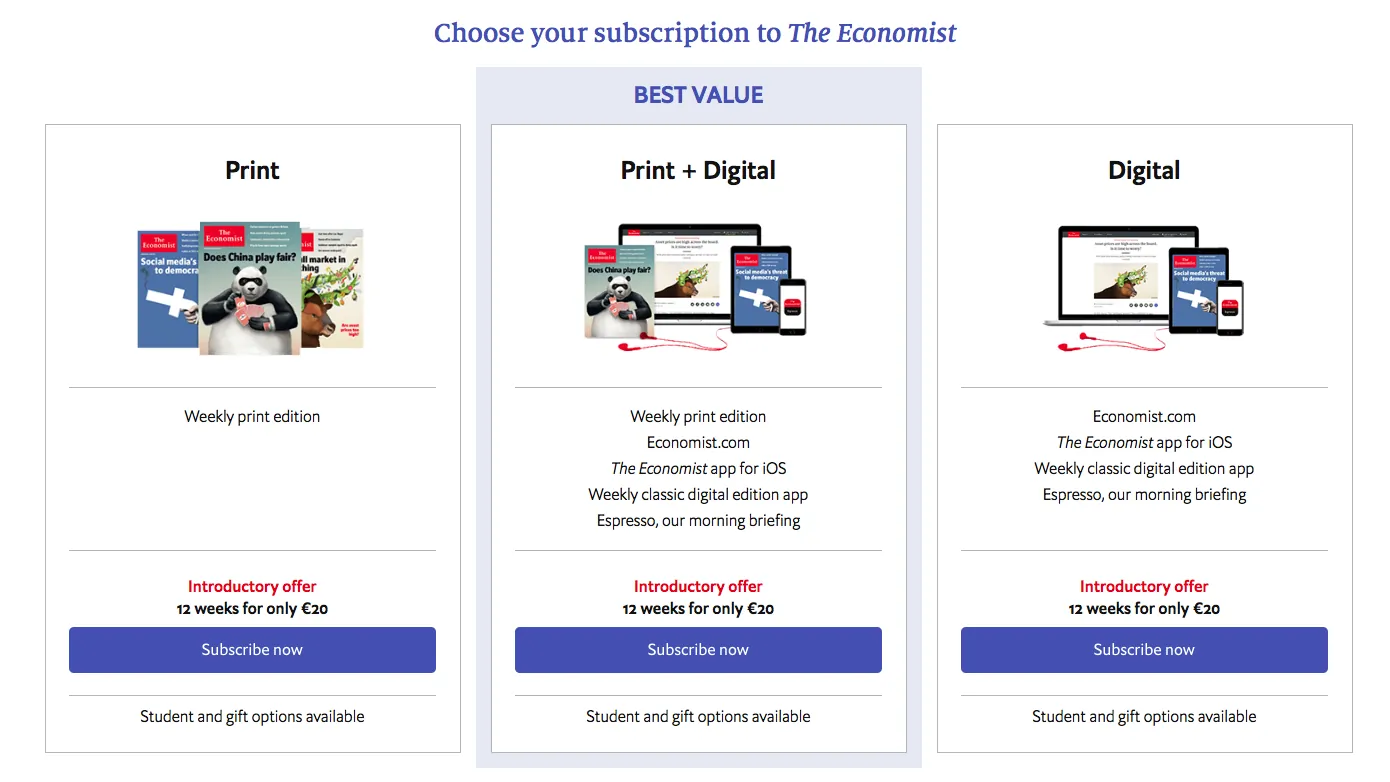
The Economist, New York Times, and several magazines employ the decoy effect to promote membership subscriptions. The Economist offered 3 different types of subscriptions:
- Web Subscription – $59
- Print Subscription – $125
- Web and Print Subscription – $125
The first (Web) offer seems reasonable at $59. The second option (only print) seems a bit expensive, but the third option - both Web and Print for the same price as the print-only subscription - seems to be a great offer. To further entice subscriptions, The Economist offered the three subscriptions at the same price.
Experimental results
Dan Ariely, a Professor of psychology and behavioral economics and author of Predictably Irrational, tested this phenomenon with his MIT students. During this test, he asked the students to choose a subscription. The results were as follows:
- Web Subscription – $59 (16 students)
- Print Subscription – $125 (0 students)
- Web and Print Subscription – $125 (84 students)
Total revenue: $11,444 The majority of students selected the third option (dominating) and none of them selected the second option (the decoy). Ariely performed a second test and removed the decoy product and the results were:
- Web Subscription – $59 (68 students)
- Web and Print Subscription – $125 (32 students)
Total revenue: $8,012 This time, however, most of the students preferred the first subscription. By adding a decoy product, Ariely improved the subscriptions by c.a. 30%.
How Apple uses the decoy effect
Apple Inc. has mastered the decoy effect to direct customer purchases. When Apple unveiled its new iPod, the pricing was as follows:
- 16GB for $229
- 32GB for $299
- 64GB for $399
In other words, you get double the storage capacity for an additional $70; you also get more features, such as a 5MP iSight camera and iPod Touch Loop. However, if you opt for double the capacity (32GB to 64GB), you pay an additional $100, but you don’t get extra features. Therefore, you might conclude that the 32GB version offers the best value for money. So, only a few would buy the 16GB version and even fewer would opt for the 64GB version. But, the fact is, the 16GB and the 64GB versions are the decoys to make the 32GB version more appealing and the best option. Apple also uses the decoy effect for its higher-priced products, such as MacBook Pro.

Restaurants use the decoy effect when designing menu cards; the design is based on guiding the person to those dishes with the highest profit margin. Likewise, the decoy effect can be used to influence elections, as Shankar Vendentam discussed in the Washington Post. The 3rd candidate in a major election is the decoy, causing voters to choose between the two front-runners. The decoy effect is subtle, yet powerful. Once you begin to understand how it works, you start to see it everywhere.
How can you overcome this effect?
Consumers can recognize and resist the decoy effect by employing several strategies and developing a critical approach to decision-making. Being aware of three-option scenarios is crucial, as the decoy effect is most powerful when three choices are presented. When encountering product or service offerings in groups of three, consumers should be particularly cautious, as this may indicate the presence of a decoy designed to influence their choice.
One effective strategy is to determine needs and preferences beforehand. By researching products and establishing clear criteria for what’s important before making a decision, consumers can better resist the influence of decoys. This approach is especially helpful for those familiar with the products they’re considering. It’s also important to look beyond price and quantity, avoiding the trap of focusing solely on these criteria. Instead, consumers should consider all relevant attributes and how they align with their specific needs.
Actively seeking additional information can significantly reduce susceptibility to the decoy effect. By searching for more options or gathering more details about products, consumers can make more informed decisions. Adopting a vigilant mindset is equally important. Approaching decisions with a critical eye and evaluating options carefully, rather than making quick, intuitive choices, can help overcome the decoy effect’s influence.
Consumers should also consider the concept of anticipated regret. By thinking about how they might feel if their choice turns out poorly, they can often make better decisions that are less influenced by decoys. It’s also wise to avoid making important decisions when mentally fatigued, as the decoy effect tends to be more influential when mental resources are depleted.
Being wary of “too good to be true” deals is another key strategy. If an option seems absurdly priced or valued compared to others, it may be a decoy designed to influence the choice towards a more expensive option. Using budgeting tools can also be helpful, as they can assist in sticking to planned spending and avoiding impulsive purchases influenced by decoys.
Finally, seeking diverse opinions can provide valuable perspective. Consulting with others, particularly those less prone to impulsive decision-making, can offer different viewpoints on the available choices and help identify potential decoys.
Written by

Mithun Sridharan
Founder, LinkPress
Mithun is a strategist, advisor, educator, and speaker focused on helping leaders make better decisions in environments shaped by change, complexity, and emerging technology. His work brings together leadership, management consulting, digital transformation, and artificial intelligence in a way that is practical, grounded, and commercially relevant.
Related Posts
5 Pillars of Psychology
five pillars of psychological well-being that drive performance
Mithun Sridharan- Psychology
- Mental Models
- Concepts
Law Of Unity
Strength is found in collective unity
Mithun Sridharan- Laws
- Leadership
- Psychology
- Concepts
- Methodologies
- Mental Models
Law Of Impermanence
Embrace change. It fuels true professional adaptability
Mithun Sridharan- Laws
- Leadership
- Mental Models
- Concepts
- Psychology