- Innovation
- Leadership
- Frameworks
- Concepts
Amara's Law
We tend to overestimate the effect of a technology in the short run and underestimate the effect in the long run
Technological advancements often generate significant excitement, fueled by superlatives and promises of revolutionizing existing systems. These promises range from transforming entire industries to saving the planet. However, the true impact of these technologies often takes years to materialize, and the initial enthusiasm often wanes. This phenomenon is captured by Amara’s Law: “We tend to overestimate the effect of a technology in the short run and underestimate the effect in the long run.”
This overestimation in the short term is often driven by several interested parties. Developers, operators, and providers of the new technology have a vested interest in promoting its potential. Marketers and sellers amplify the message, creating a sense of urgency and opportunity. Professional publications and experts offer their analyses, bolstering their own credibility and driving demand. Early adopters, eager to embrace the latest innovations, further contribute to the hype.
Hype Cycle
The hype cycle, developed by Gartner analyst Jackie Fenn, provides a framework for understanding these phases. It outlines a progression from a “technology trigger” to a “peak of inflated expectations,” followed by a “trough of disillusionment,” a “slope of enlightenment,” and finally a “plateau of productivity.”
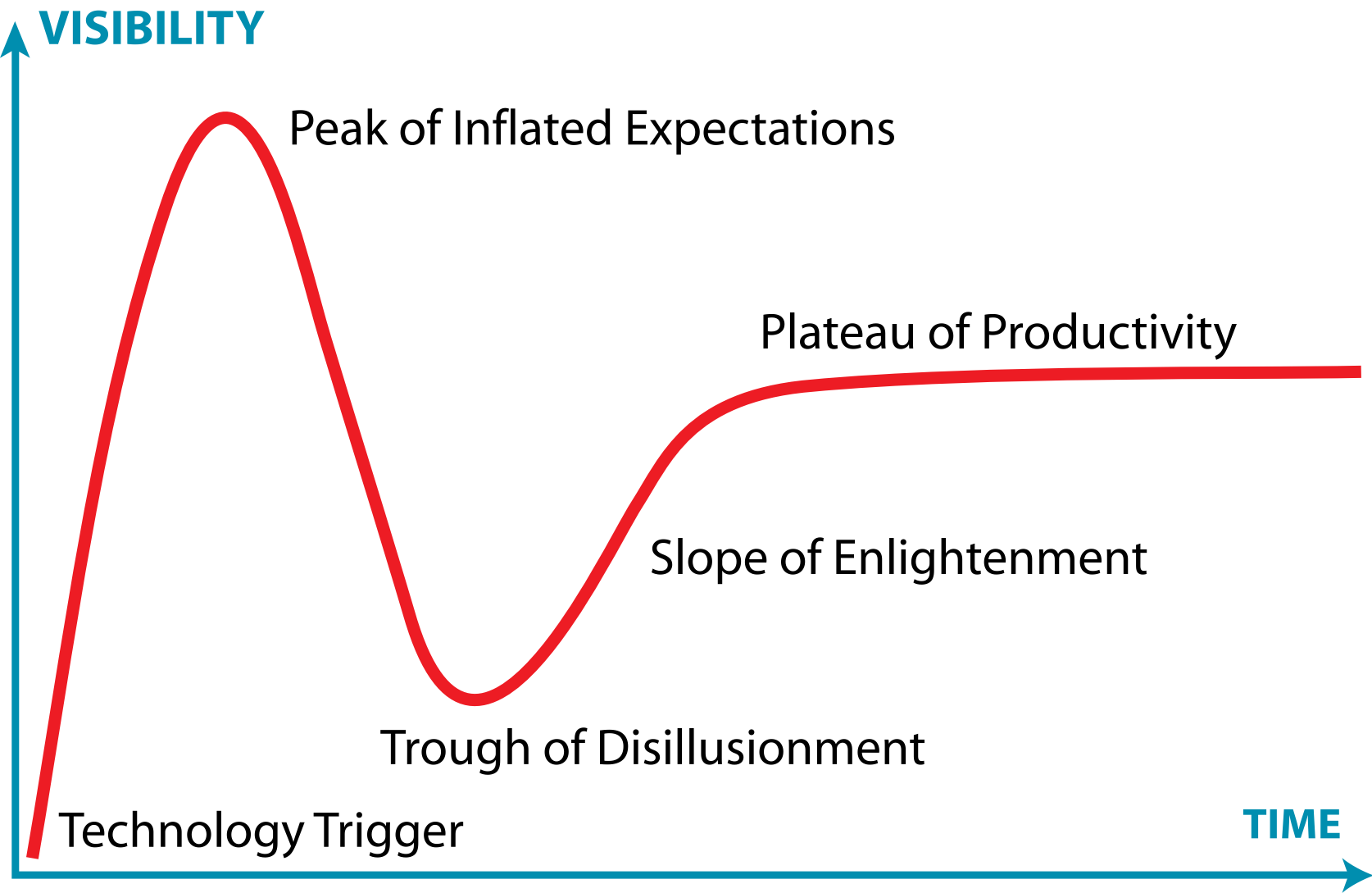
Amara’s Law directly addresses the peak of inflated expectations (overestimation in the short run) and the trough of disillusionment (underestimation in the long run).
During the ascent to the peak, numerous companies attempt to capitalize on the hype, generating maximum attention. However, this peak is inevitably followed by a decline as the technology struggles to meet the inflated expectations. The revolutionary technology is often still immature, lacking the stability and support of more established technologies. Issues such as limited user support, lack of tutorials, scaling challenges, and unreliable release schedules contribute to the ensuing disillusionment.
In summary, technological hype is driven by a confluence of factors, leading to inflated short-term expectations followed by a period of disillusionment as the technology matures.
Case Study - Clubhouse
The social media app Clubhouse provides a compelling example of Amara’s Law in action. In 2020, Clubhouse, with its blend of live podcasting and social conferencing, became a sensation. Marketers, consultants, and advisors flocked to the platform. Companies deployed influencers to host live conversations, and a significant amount of promotion was generated organically by enthusiastic users. Many saw Clubhouse as a low-cost opportunity to establish a new communication channel for brand building and profit generation. This period perfectly exemplifies the first part of Amara’s Law:
We tend to overestimate the effect of a technology in the short run
However, the hype surrounding Clubhouse quickly dissipated. Criticism regarding data privacy emerged, competition for user attention intensified, and distinguishing valuable content became increasingly difficult. User growth stagnated and then declined. Many conversation hosts and listeners abandoned the platform. This rapid decline is a classic example of the “trough of disillusionment” in the hype cycle.
However, does this mean Clubhouse is now entirely irrelevant? Probably not. Does this situation create opportunities for those who persevere or for late adopters? Likely yes. But many early adopters, caught up in the initial hype, may miss these long-term opportunities, illustrating the second part of Amara’s Law: “We tend to … underestimate the effect in the long run.”
In short, the Clubhouse phenomenon demonstrates the overestimation of short-term impact followed by a period of disillusionment, potentially leading to an underestimation of long-term potential.
Critiques & Considerations
Despite its simplicity and memorability, Amara’s Law has faced criticism. Some argue that there is no conclusive scientific evidence that “we” universally overestimate the short-term effects of all technologies. It is possible that overestimation occurs primarily with hyped technologies and is driven by market participants with vested interests.
Similarly, there is limited empirical evidence to support the claim that “we” universally underestimate the long-term impact. Some stakeholders maintain a long-term perspective and continue their efforts until the technology’s potential is realized.
Furthermore, some argue that “we” can be overly critical of new technologies from the outset. Electric cars, for example, are praised for their cleaner operation compared to combustion engines but are also criticized for the environmental impact of battery production, the limited availability of charging infrastructure, and long charging times. This initial skepticism can coexist with both overestimation of short-term hype and underestimation of long-term potential.
Finally, there is debate about whether Amara’s Law is primarily useful for passive hindsight or can be actively applied when dealing with new technologies. Can we use it to proactively manage expectations and avoid the pitfalls of the hype cycle?
In summary, while Amara’s Law provides a valuable framework, it is important to acknowledge its limitations and consider alternative perspectives.
Applying Amara’s Law
Despite the critiques, Amara’s Law offers valuable lessons for managing expectations and strategic planning regarding technological advancements. It highlights the importance of separating genuine potential from hype-driven narratives. By recognizing the cyclical nature of technological adoption, organizations can avoid overreacting to short-term trends and focus on long-term value creation.
When evaluating a new technology, it is crucial to conduct thorough research, assess its practical applications, and avoid being swayed by exaggerated claims. Consider the long-term implications, potential challenges, and the time required for the technology to mature. This balanced approach can help organizations make informed decisions about technology adoption and investment.
For example, when considering artificial intelligence (AI), it is important to distinguish between the current capabilities of AI and the more futuristic portrayals often seen in media. While AI has made significant strides in areas like image recognition and natural language processing, it is still far from achieving general-purpose intelligence. Recognizing this distinction helps avoid both overestimating the short-term impact of AI and underestimating its long-term transformative potential.
Written by

Mithun Sridharan
Founder, LinkPress
Mithun is a strategist, advisor, educator, and speaker focused on helping leaders make better decisions in environments shaped by change, complexity, and emerging technology. His work brings together leadership, management consulting, digital transformation, and artificial intelligence in a way that is practical, grounded, and commercially relevant.
Related Posts
Three Circles Framework
The Three Circles Framework helps develop effective value propositions and positioning strategies
Mithun Sridharan- Innovation
- Leadership
- Frameworks
- Models
IDEO DFV Method
DFV methodology helps managers appraise the success of a product / service along 3 critical dimensions
Mithun Sridharan- Frameworks
- Concepts
- Innovation
- Methodologies
Innovation vs Incremental Improvement
Mistaking gradual refinements for genuine breakthroughs leads to strategic stagnation and wasted capital investments
Mithun Sridharan- Innovation
- Business Strategy
- Frameworks
- Continuous Improvement
- Corporate Transformation
- Strategic Growth